Defining factors promoting successful virtual elementary school nutrition education: lessons learned during the pandemic
While previous literature has described aspects of virtual programs that increase participation, there is a lack of research that examines virtual nutrition programs at the elementary level with input from teachers and family. Our study explored differences in student knowledge of nutritional topics between in-person and virtual programs and also identified elements that can make virtual nutrition education programs most effective from teacher and family perspectives by leveraging strengths related to support, community, and engagement.
Some previous comparisons between virtual and in-person nutrition education programs have suggested virtual programs can lead to higher intake of whole grains and fruits (Saxe-Custack et al., (2023), Prowse, Carsley (2021), Sharma et al., (2021)). Studies of graduate-level nutrition learners also suggest virtual learning arenas are preferred due to perceived improved interactivity, connectedness, and improved accommodation of various learning styles (Heuberger, Clark (2019)). On the contrary, other suggest in-person curriculum can also lead to improved dietary intake (Jeans et al., (2023), Metcalfe et al., (2022)). Additional studies have suggested that there are actually minimal differences between virtual learning modalities when compared directly to their in-person counterparts (Watts et al., (2022)). Because of these inconsistencies between direct comparisons between in-person and virtual learning, it can be difficult to determine the ideal modality to provide vital nutrition curriculum to students.
When comparing post-lesson scores between 2021 to 2018, we saw a decrease in student performance. However, teachers unanimously endorsed TFD as a beneficial part of their classroom activities with a preference to continue lessons in-person and suggestions to increase student engagement and participation.
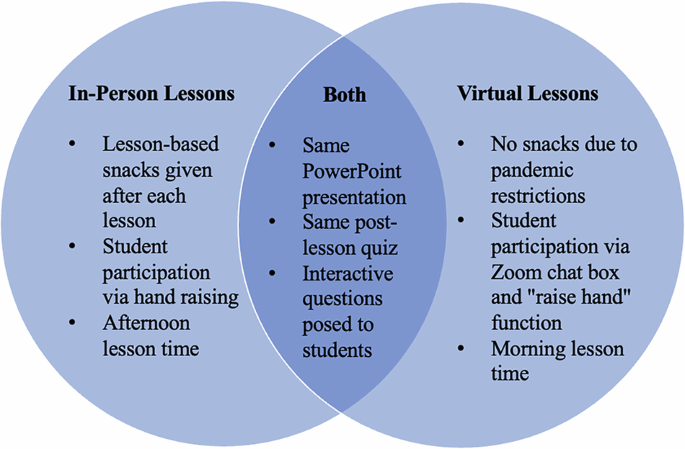
Potential factors that could have contributed to the decrease in quiz scores may stem from technological barriers of the virtual format including student burnout, reduced interaction among students, diminished experiential learning due to inability to participate in hands-on nutrition activities, virtual or home distractions, and differences in lesson timing. Our findings also align with previous studies that have noted the limitations of virtual learning formats (Stelitano et al., (2020)). All teachers interviewed highlighted the effects of virtual learning during COVID-19 on their students. The decrease in quiz scores were consistent with teachers’ concerns during interviews about global knowledge deficits induced by the pandemic virtual learning structure. Based on their feedback, students experienced widespread decreases in knowledge for all third-grade topics, and new incoming third graders the following year showed lower baseline knowledge when starting third-grade than expected from the teachers based on previous in-person years. The interviewed teachers attribute this student decrease in knowledge and retention to virtual learning and pandemic challenges. Although nutritional knowledge was less than prior years by the end of the program, we acknowledge this finding was located in the setting of structural factors limiting knowledge beyond our program. We believe students deserve enrichment in nutrition in the best and most appropriate format that is available. In a pandemic or other circumstance in which virtual formats are the best option, we believe effective nutrition education may be offered utilizing some of the key strategies illustrated here.
Regarding interaction during the summer program, we found that participants enjoyed interacting with their family members and the student-instructor through the meal preparation. Past studies have shown that interactions such as student-teacher and student-content increase overall achievement and student engagement (Liao et al., (2021), Murimi et al., (2018)). Focus groups with families from the summer program yielded positive participant feedback with the virtual delivery method, particularly because the families had a scheduled time to create a family meal together centered around the nutrition topic. Shopping at the farmers market yielded mixed feedback related to produce selection, prices, and limited hours. Overall, families were satisfied with the knowledge and experiences their children gained during the program.
The themes of support, community, and engagement work together synergistically, but they also have noted individual contributions to the virtual learning environment.
Support
Throughout both the summer and school year virtual projects, a triangulated support system was evident between teachers, parents, and students to promote improved nutritional knowledge and healthy eating. The established relationship between parents, teachers, and students previously developed is modified with TFD program for additional avenues of support (“Triangle of Support”, 2022). TFD received support from teachers, students, and parents through program feedback and participation, while TFD provided support by increasing nutrition program availability and educational aids available to students and parents (Fig. 5). It must also be noted that students experiencing food insecurity may not have had access to in-person school nutrition programs, such as subsidized school lunches, during the pandemic that supported their overall health in previous years, placing a greater emphasis on the importance of continuing in-person nutrition programs with shared food elements.

This figure depicts the support systems that were present during lessons that should be leveraged by current and future educational programs. Three circles containing “parents,” “students,” and “teachers” are arranged in a triangular pattern connected by bidirectional arrows to represent the bidirectional support from each of these groups towards each other. In the center of the triangle is an additional circle labeled “TFD” representing The Food Doctors. This circle is also connected to the “parents,” “students,” and “teachers” circles through additional bidirectional arrows to show the support systems that can be accessed and optimized with educational programs from outside the school system such as TFD (“Triangle of Support”, 2022).
Students played a major role in relationships with parents and teachers. Students would discuss information from TFD lessons with both parents and teachers, providing further exposure to lesson topics (Cory et al., (2021)). Parents noted that their children would teach them concepts from the lessons as they prepared meals afterwards. After the summer program, families reported further conversations about the lessons both when shopping for meals and eating dinner, illustrating the continuing conversation between family members. These conversations after lesson delivery were examples of how leveraging the relationship between students and their supporting adults can promote further reinforcement of content.
For programs interested in implementing similar nutritional programs in schools and the community, we recommend optimizing support channels by sending home summary sheets or videos after sessions to strengthen topics seen during the sessions and increase participant and family connection to the program, eliciting feedback from research participants to improve a program’s reach and impact during and after a program is implemented, and maximizing connections between parents, teachers, students, and the curriculum in the grade school environment to support further interaction and familiarity with topics. Utilizing elements of support that simultaneously incorporate student engagement and the local community can provide further synergy within this framework.
Community
Continuing the partnership between the medical community and local schools to support students remained the primary goal of TFD project. When pandemic restrictions challenged the continuation of the program, discovering a new path for the lessons in a timely manner while also supporting students, parents, and staff became the updated objective of the program. Adaptation of curriculum and close partnerships with the schools bolstered the commitment to the health of the students. Because the relationship between the schools and the program had already been established for many years, there was an element of trust with school stakeholders that enhanced the ability of the program to continue virtually and recruit families during the summer sessions. Previous studies in nutrition education and support have also shown that community relationships can take years to develop (Tanumihardjo et al., (2023)). Even though the new learning programs were based in a virtual context outside of the community (mostly in students’ individual homes) we found that leveraging the community dynamic improved the virtual learning environment.
Although the program joined the school community as an external partner coming into each classroom, there were noted benefits to this dynamic. Teachers discussed that students were more engaged with lesson topics due to the novelty of having outside guests facilitate the program. The presence of guests from the medical school also prompted further classroom conversations about continuing education through graduate school and the role of doctors in the community, topics which received positive reviews from teachers. Integrating into the school campus and gathering benefits and barriers to utilizing the farmers markets provided valuable suggestions from participants to further improve the program.
Given the feedback from parents and teachers, we recommend similar programs to integrate into the school or local community and include community resources, such as farmers markets, to promote the role of the educational program within preexisting frameworks.
Engagement
The program received the greatest number of opportunities for positive changes within the engagement arena. Feedback from teachers and families suggested engagement through hands-on activities (like snacks that had been made in the classroom in previous years during in-person lessons) and resources sent home could help bridge the gap between the post-lesson quiz scores seen this year as compared to previous in-person years. Many of the support systems identified by teachers to improve the school year lessons and increase parental involvement (such as lesson materials available at home) were also mentioned by parents during the summer program as lesson highlights. The student-instructors’ roles as role models and TFD as a unique learning experience helped promote engagement, while fading interest in online learning platforms and limited opportunities for hands-on activities and at-home activities decreased engagement.
It is important for programs seeking to update curricula to hold feedback sessions to reinforce the connection and cooperation between involved parties. These focus group sessions ultimately propelled the program to develop a stronger framework to continue the goal of effective and sustained nutrition education for students while also supporting local school partners.
Limitations
Limitations of the school year program included no virtual pre-lesson quiz data from the 2020–2021 school year for comparison to post-lesson quiz data and a 26.6% reduction in potential sample size due to students opting not to elect to complete the quiz virtually. Limitations to the summer program include limited sample size and potential participant bias. There was possible response bias due to group teacher focus groups conducted with all the teachers and educational support staff from the third-grade team, although participants were included to answer independently from others on their teaching team. Potential volunteer bias may alter the group demographics as they may have different motives than the general public for joining the program. Since the family interviewer also taught the summer lessons, a respondent bias may be present. These limitations could have decreased the diversity in teacher, student, and parent responses, therefore effectively reducing variability in the data. To limit these biases, future research could involve larger sample sizes or use interviewers outside of the research team. The percent agreement for focus group coding was 84% for the virtual school year program and 75% for the virtual summer program.
link