What It’s Like To Be An International Affairs Graduate School Administrator in 2025
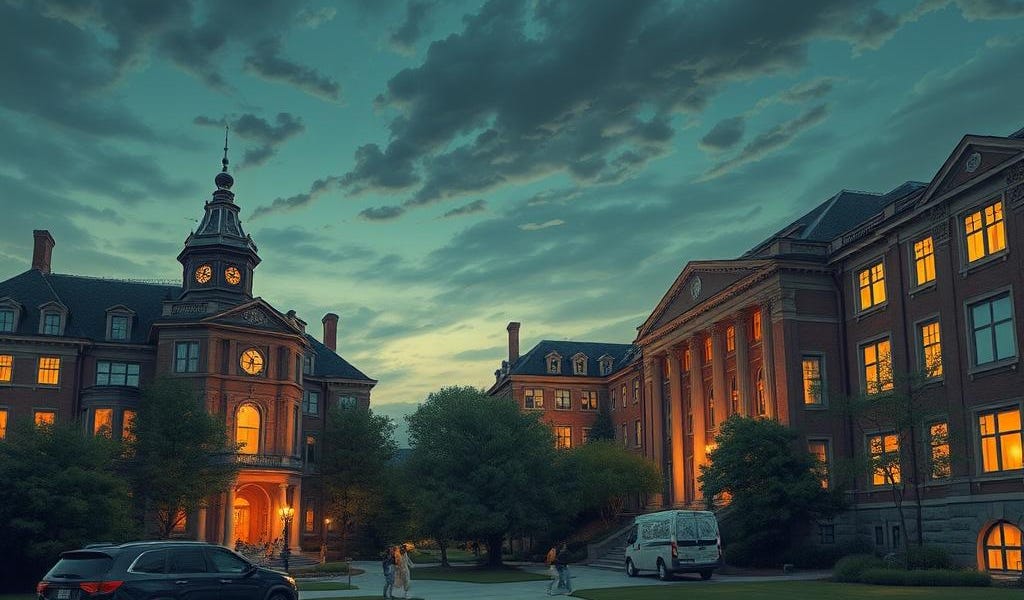

I have now been an academic dean for seven weeks, and I’m not gonna lie, the rhythms of this job are different from those of being a professor. For a prof, the summer is normally the time when one focuses like a laser beam on writing and research. Once spring semester classes had ended I would always make a list of everything I wanted to write over the summer — and then fret about all the ways I fell short. Still, during the summer a prof’s time is largely their own.
The job of a dean is different. I have had much less time to write and much more time to attend meetings. It feels a bit more like firefighting, making sure that the conflagration of the day does not break containment. I have to take my satisfactions from different tasks. There are days when I think to myself, “I wrote the hell out of that email” or “I crushed that memo.”
Still, both jobs are facing unique stresses right now. Earlier this week Dave Karpf wrote about what it’s like to be a political communications professor right now. Being a tenured professor is pretty great, as Karpf correctly notes. But this section hit me hard:
It is even moreso a gift because jobs like mine have become vanishingly rare.
My peers and I didn’t exactly pull up the ladder behind us or anything. It’s more like we ran across a crumbling bridge. We arrived at the tail end of American government treating higher education as if it were a priority worth investing in. Tenure-line professorships aren’t cheap. Once you start treating academia as a business and trying to identify cost savings, you’ll eventually decide to try educate those student-consumers cheaper-and-worse via a more precarious workforce. (Mark this down as another example for the “we can have nice things, but they either won’t maximize profit or they won’t last” file.)
And the job itself is, well, fraying.
Most of the headlines I see about higher ed these days focus on the AI problem. For me, the much bigger issue is the authoritarianism problem.
The hard-working staff here at Drezner’s World largely agrees with Karpf. Artificial intelligence is a challenge, but hardly an insurmountable one. Indeed, now that I’m the Fletcher School’s academic dean, one of the things I’m looking forward to noodling over is how to to get students to use AI in an intelligent, ethical manner. I am cautiously optimistic that it can be done.
The authoritarianism problem, however, is a doozy. Consider two New York Times stories from this past week. The first one, by Michael C. Bender, Alan Blinder and Michael S. Schmidt, details how Trump basically wants to extort money from the Ivy League and University of California system:
In May, cabinet officials and West Wing aides brought President Trump a potential settlement with Columbia University. But instead of giving his sign-off, he issued a new demand.
The school needed to pay $200 million, Mr. Trump told his team. The university’s cost for a deal soared from zero dollars to nine figures in the course of a single meeting.
The sudden stipulation, described by six people familiar with the episode and which has not been previously reported, jarred university leaders. They had seen the fierce backlash that followed when major law firms struck deals with the White House and promised to pour resources into seemingly benign causes favored by Mr. Trump. And although negotiations were still unfolding, they had already spent weeks working through policy changes intended to meet the administration’s original dictates around addressing antisemitism on campus….
Federal agencies under Mr. Trump’s control have spent months squeezing elite public and private colleges with civil rights investigations, freezing billions in federal research money and threatening to prevent international students from enrolling.
But privately, the president saw dollar signs — and the chance to put his personal stamp on institutions that prize nothing more than their independence.
Critics have likened Mr. Trump’s methods to extortion. The White House has said that the goal of extracting money from universities is to enhance trade schools, apprenticeships and other “real world” training.
Now, a hefty payment appears to be a bedrock provision for any deal, including one with Harvard University, which the administration sees as its biggest prize, and which has billions in federal grants at stake.
Let’s be clear: what Trump is doing is not “like” extortion, it is the textbook legal definition of extortion: “the gaining of property or money by almost any kind of force, coercion, threat of violence, property damage, harm to reputation, or unfavorable government action.” Furthermore, the Trump White House claim that this is all about enhancing trade schools is horseshit. There are myriad other perfectly legal ways that the federal government can fund vocational training. The only reason to extort money from private universities to do with is to punish universities that Trump views as hostile to him.
The point is, Trump is trying to weaken universities by cutting their financial legs out from under them. Tufts University has been fortunate, in that the university has not been directly targeted like Harvard or Columbia. But this elides three deeper concerns. First, there is the sense that once Trump is done with the Ivy League he will aim his weaponized government at any institution of higher education that has has an endowment he can threaten.
Second, the federal government’s research funding freezes have hurt all universities, including Tufts. My university has a medical school, a dental school, a veterinary school, and a school of nutrition. NIH cuts hit all of these schools hard.
Finally, as a school of international affairs, Fletcher relies on attracting students from across the globe. And as the NYT’s Anemona Hartocollis explains, Trump has made that an extremely difficult market to tap:
Even students from China and India, the top two senders of international students to the United States, have been flummoxed by a maze of new obstacles the Trump administration has set up to slow or deter people entering the country from abroad.
Between the federal government’s heightened vetting of student visas and President Trump’s travel ban, the number of international students newly enrolled in American universities seems certain to drop — by a lot….
A survey of over 500 colleges and universities by the Institute of International Education, a nonprofit which works with governments and others to promote international education, found that 35 percent of the schools experienced a dip in applications from abroad last spring, the most since the pandemic.
In China and India, there have been few visa appointments available for students in recent months, and sometimes none at all, according to the Association of International Educators, also known as NAFSA, a professional organization. If visa problems persist, new international student enrollment in American colleges could drop by 30 to 40 percent overall this fall, a loss of 150,000 students, according to the group’s analysis.
Some students have given up on enrolling in U.S. schools entirely out of anxiety over the political environment in the United States. Others are staying away because they worry that even if they were to gain entry, they would effectively be trapped, unable to do things that other students can, like apply for internships or travel home over the holidays to see their families….
Many international students pay full tuition and are a revenue source that schools have come to rely on, including to help underwrite financial aid for other students. It’s part of the business model.
The Trump White House claims that this is really about national security — but again, that is a horseshit claim. Furthermore, it is in direct contradiction to Trump’s stated intent to reduce the U.S. trade deficit. As the hard-working staff here at Drezner’s World has stressed in recent years, higher education is one of America’s leading export sectors. That Trump is willing to piss away that advantage suggests his motive is punitive rather than populist.
Here is where being a university administrator during Trump’s enhanced authoritarianism has been something of a mixed blessing. On the one hand, it has been horrible to watch so many prospective students accepted to Fletcher subsequently find themselves unable to get a visa appointment with an overworked and understaffed consular staff. For an administration ostensibly interested in streamlining government, they sure know how to do Kafkaesque.
On the other hand, however, one of the benefits of moving into administration is seeing the daily miracles that Fletcher’s staff has pulled off. Thanks in no small part to their efforts, most of our international students have procured visas in time to attend school this fall. What looked initially like an existential threat has been reduced to a manageable problem. This means Fletcher’s international students will still comprise a healthy fraction of the school’s population, and U.S. students will still be exposed to a variety of cosmopolitan peers.
One of the unexpected blessings of entering university administration has been to witness firsthand exactly what the staff has to do to keep the machinery running. It has been an honor to seem them confront an existential threat from a capricious, malevolent federal government and manage the problem.
There are times when it feels like the U.S university system will not survive the Trump administration’s full-spectrum attack. But there are more times when I am grateful for the professionalism and industriousness of those who work at institutions of higher education to ensure that the system continues to function.
There may come a day when the Trump administration makes life impossible for the U.S, higher education sector. But today is not that day.
link